

The National Cultural Foundation
West Terrace,
St. James, Barbados
246-417-6610
Most Recent

NCF TO LAUNCH SAILORS’ VALENTINES ANIMATION FOR UNESCO INTERNATIONAL INTANGIBLE CULTURAL HERITAGE DAY

A Little Rum, A Lot of Imagination: Inside the Barbados Food and Rum Festival’s Cocktail Creations

Javon Cummins Dares You to Taste Barbados Differently at Barbados Food and Rum Festival
View All
Most Popular
6
insert_link
share
close
The Poems He Tried To Hide
Kerry Belgrave took his poems to school, hoping nobody would see them.
He was a young teacher at St. George Secondary School, using the privacy of his lunch break to sort through writing he had accumulated and tucked away. He enjoyed writing. He simply did not believe the work was good enough to share.
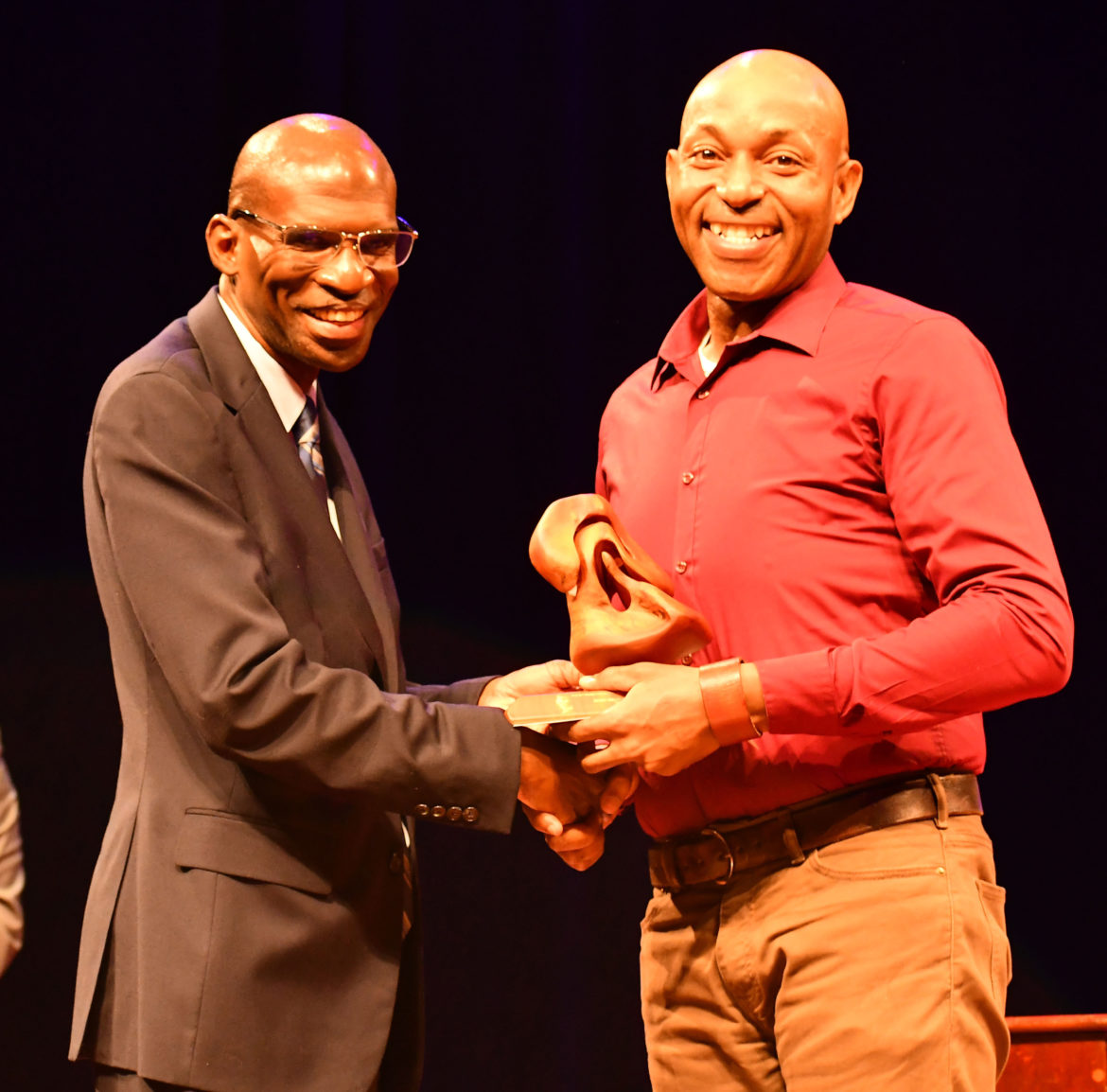
Then his Head of Department, Mrs Molly Inniss, caught sight of it.
Her excitement startled him. Here were words he had hidden away, provoking an emotional response he had never imagined. “She saw it in me even when I did not see it in myself,” Kerry recalled.
For the poet, linguist and teacher, learning to trust his voice would involve several such encounters: people who recognised something in his work and opportunities that helped him develop it. NIFCA runs through that story, sometimes in unexpectedly practical ways.
With all of his literary accolades, his first success at the festival actually came through music. In 1994, Belgrave was a member of the St. Leonard’s Boys’ School choir, directed by Colin Allman and Andrew Allman. Fellow choir member Sharon Conliffe selected him and classmate Christ Paulius to perform Henry Smart’s The Lord Is My Shepherd as a classical duet for NIFCA.
Belgrave was also preparing for CXC examinations, without the money for fees or the materials he needed. The duet earned a gold medal and the James Millington Award for Excellence in Music. Its $1,000 prize helped meet those examination expenses.
“I never imagined that singing a classical duet for NIFCA would allow me to do so,” said Kerry about his first taste of success.
At about 16, he remembers being struck by the formality of the occasion and beaming with pride in Barbadian excellence. The choir remains one of his most treasured school experiences. His serious commitment to writing emerged later, during a much less assured period.
Fresh out of school and unemployed, he felt overwhelmed by uncertainty and what he describes as “a palpable sense of meaninglessness”. Sitting in his grandmother’s rocking chair one day, he recalls a voice telling him plainly: “write”.
“A switch flicked on immediately, and that’s when I started writing seriously,” said Kerry.
Writing offered liberation from the turmoil around him. Sharing it was another matter. Intensely private, he stashed the poems away until Christmas cleaning revealed just how many he had accumulated. The folder he began organising then still exists.
Eventually, the work brought him into another NIFCA spotlight. By his first Literary Arts Gala, he was in his early twenties and more reserved than the schoolboy who had sung the classical duet. The quality of the production mesmerised him; the attention required adjustment.
The Prime Minister’s Scholarship for Excellence in Literature subsequently opened the door to the University of the West Indies, where he discovered the possibilities at the intersection of language, linguistics and literature. He grew to love linguistics. Years after graduating, he was invited to chair the Linguistics Special Committee and was recognised among the Department of Language, Linguistics and Literature’s first group of Distinguished Alumni.
“I still can’t find the words exactly to express how moved and grateful I felt”
Another memorable opportunity took him to Trinidad in 2019, alongside fellow Barbadian writer Amanda Haynes, for the Cropper Literary Retreat at Camp Balandra.
Supported by the NCF, the Cropper Foundation and UWI St. Augustine, the three-week experience brought Caribbean writers together for intensive critique led by Professor Emeritus Funso Aiyejina and Dr Merle Hodge.
After discussing his work, Hodge described his poems as “electric” and expressed surprise that she had not heard of him before. She affectionately called him “Baje”.
The memory still matters: a Caribbean literary luminary had seen him and his work.
Yet Kerry is candid about the economics behind the recognition. Being known as a professional writer in Barbados and the Caribbean, he observes, does not necessarily mean earning a living from writing.
Teaching provides his livelihood, and he loves it.
“There is nothing like teaching!”
It also feeds his creative practice. Linguistics gives him ways to explore sound, meaning and the unexpected relationships between words; teaching brings those discoveries into conversation with his students.
Studying language has deepened his affection for Barbadian expression and his belief that “Bajans speak in poems”. He is also fascinated by the meeting of digital jargon and Bajan, a hybrid he calls “web-jan”.
Even when the subject is chilling, he finds beauty in the language. His poem Murderation demonstrates that attention to voice:
Murderation
…did late
by de sea…
remember?
roun’ now so de waves
did start actin’ strange-
like how mudders is ben’ ova
n spraddle out pun de groun’
when death mek an appearance
fuh e’ child.
you remember?
Dat did someting else boy…
dat did
jus
someting
else.
Not a soul din roun’ dey to
hear dem screams fuh blue murder,
nor see de person fingernails
scratch-way de face of de Moon.
Upwards to now you ain’t hear
one word ‘bout who son or daughter
it did.
De night is who help strangle
all o’ dem tings
dead… dead… dead…
So wha de poor stars in God heaven
coulda do den, nuh?
just look down,
staring,
an’ doan unpick teet…
For Kerry, NIFCA has been “a pillar” of his development. He welcomes the regional and international promotion available to literary winners, seeing it as a way for Barbados to declare: “This is who we are!” Once, his poems were hidden in a folder. Today, he sees value in helping Barbadian writing travel far
Previous post

insert_link
share
close
NCF TO LAUNCH SAILORS’ VALENTINES ANIMATION FOR UNESCO INTERNATIONAL INTANGIBLE CULTURAL HERITAGE DAY
Rooted in Barbados’ rich cultural heritage, Sailors’ Valentines preserve a story of traditional craftsmanship, the knowledge of Black Barbadian women and the enduring relationship between people and the marine environment. [...]
Similar posts
The Poems He Tried To Hide
Kerry Belgrave took his poems to school, hoping nobody would see them. He was a young teacher at St. George Secondary School, using the privacy of his lunch break to sort through writing he had accumulated and tucked away. He enjoyed writing. He simply did not believe the work was good enough to share. Then [...]